
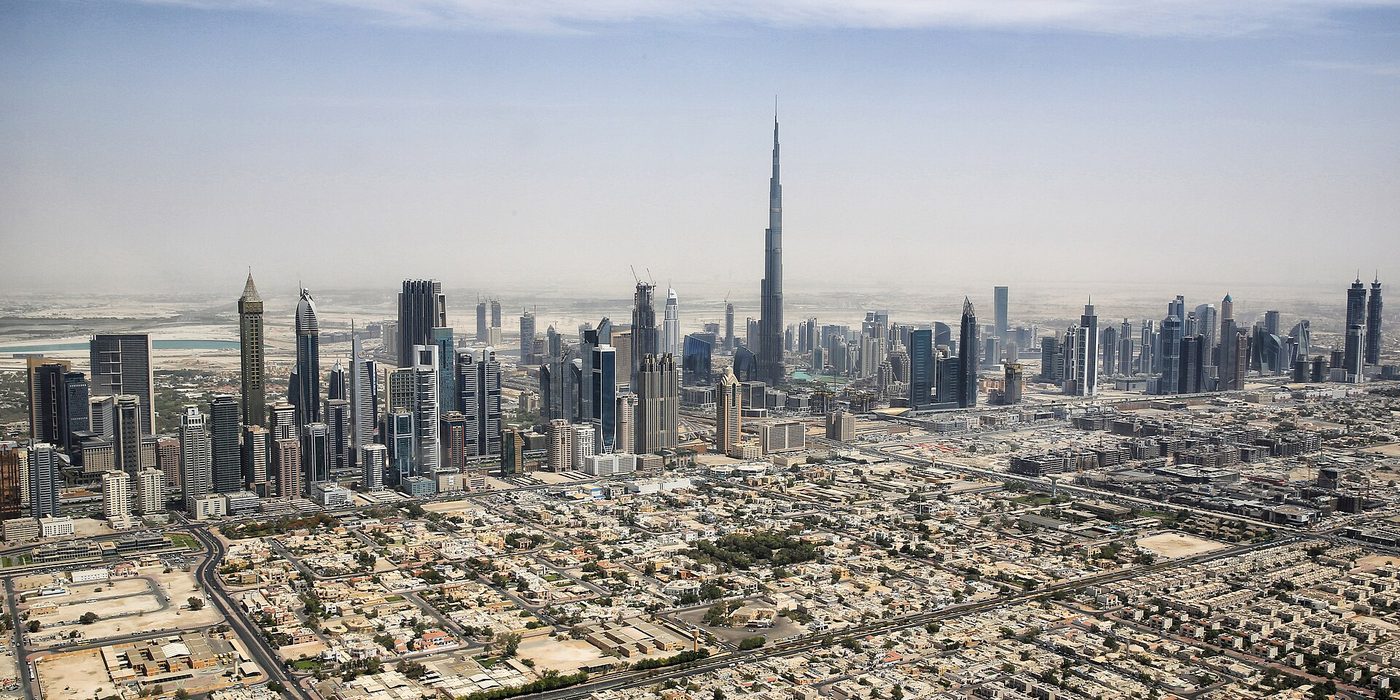
For most U.S. investors, “international real estate” conjures images of vacation condos and currency risk nobody wants to underwrite. Dubai breaks that pattern in ways that are easy to verify and hard to dismiss once you run the actual numbers. Here’s the full case, with the tax mechanics and market data that make it work.
The Currency Question, Answered First
The single biggest objection to international real estate is currency risk — you buy in local currency, and if that currency depreciates against the dollar, your returns erode even if the underlying asset performs well. Dubai’s currency, the UAE Dirham (AED), has been pegged to the U.S. dollar at a fixed rate of approximately 3.6725 AED per USD since 1997, maintained by the UAE Central Bank (centralbank.ae). This isn’t a loose managed float — it’s a hard peg the UAE has maintained through multiple oil price cycles and global financial crises.
Practically, this means a USD-based investor buying Dubai real estate is not taking on the currency volatility that comes with, say, investing in UK, European, or emerging-market property. Your AED-denominated returns convert back to USD at a functionally fixed rate. This is a genuinely different risk profile than most international diversification strategies.
The Tax Math
This is where the case gets concrete. The UAE imposes:
- Zero capital gains tax on real estate profits for individual investors
- Zero annual property tax (compare this to U.S. property tax rates that commonly run 0.5%-2.5%+ of assessed value annually, depending on state and municipality, per data the Tax Foundation compiles annually — taxfoundation.org)
- Zero tax on rental income for individual, non-business real estate investors
Dubai does levy a one-time 4% Dubai Land Department transfer fee at the time of purchase, split by convention between buyer and seller (though this is often negotiated), plus standard registration costs. This is a known, one-time, easily underwritten cost — a fundamentally different category from ongoing annual taxation that compounds against your holding period every year you own the asset.
For a U.S. investor comparing a $600,000 Dubai property to a $600,000 U.S. property with a hypothetical 1.5% effective property tax rate, the U.S. property incurs roughly $9,000/year in property tax alone — before any capital gains tax is owed at sale. Over a four-year hold, that’s $36,000+ in carrying costs the Dubai position simply doesn’t have.
U.S. citizens and residents remain subject to U.S. federal tax on worldwide income and capital gains regardless of where the underlying asset is located — Dubai’s zero-tax treatment doesn’t exempt you from U.S. tax obligations, but it does eliminate an entire layer of foreign tax drag and generally avoids double-taxation friction, since there’s no foreign tax paid to reconcile via foreign tax credit. Consult a cross-border tax advisor for your specific situation, as structuring matters significantly here.
The Off-Plan Leverage Structure
Dubai’s off-plan market — buying units directly from developers before or during construction — operates on payment structures that don’t exist in most U.S. markets:
- Typical down payments of 10-20% at reservation/contract signing
- Interest-free installment plans through the construction period, structured as milestone-based payments (e.g., 10% at foundation, 10% at podium level, and so on)
- Remaining balance due at, or sometimes after, handover — depending on the developer’s post-handover payment plan offering
This creates meaningfully different capital efficiency than U.S. development financing, where construction loans carry market interest rates that compound throughout the build period. A 20%-down, interest-free structure means your capital-at-risk during the multi-year construction window is a fraction of the total purchase price, with no financing cost eroding returns while the building is underway.
This is precisely why underwriting discipline on the developer relationship matters more in Dubai’s off-plan market than almost any other variable. Payment plan terms vary significantly by developer — we passed on a Dubai Marina off-plan opportunity specifically because the developer’s payment plan required 50% upfront versus the 20% terms available on comparable Sobha and Ellington projects, which would have doubled our capital deployment for an identical exit timeline and destroyed the leverage advantage that makes this market work.
The Demand-Side Case: Dubai 2040
Tax structure and payment terms matter, but only if underlying demand supports appreciation and liquidity at exit. Dubai’s official urban master plan, the Dubai 2040 Urban Master Plan, published by Dubai’s government, targets population growth from approximately 3.3 million residents to as much as 5.8 million by 2040 under its planning scenarios, with substantial new residential, commercial, and industrial land allocated to support that growth (dubai2040.ae, Dubai Media Office). This is a government-published, publicly available planning document — not third-party projection.
That population growth trajectory is being driven by several structural factors:
- Golden Visa program offering long-term residency (10 years) to qualifying investors, professionals, and property owners above set investment thresholds, reducing the transient-expat dynamic that historically characterized Dubai’s population
- Zero personal income tax, continuing to attract high-earning professionals and entrepreneurs relocating from higher-tax jurisdictions globally
- Free zone expansion across finance, technology, and logistics sectors, diversifying the economy beyond its historical oil and tourism base
Risk Factors Worth Naming Directly
No honest case for any market omits the downside. Dubai real estate carries specific risks U.S. investors should underwrite explicitly:
- Developer execution risk: Off-plan investing means your capital is committed before the asset exists. Developer track record, financial strength, and delivery history matter enormously — which is why we work exclusively with established, publicly tracked developers like Sobha Realty and Ellington Properties rather than smaller, unproven builders.
- Handover timeline risk: Construction delays are a real possibility in any development market, and off-plan investors should underwrite realistic (not best-case) handover timelines.
- Market cycle risk: Dubai real estate has historically been more cyclical than U.S. residential markets, with a notable correction following the 2008-2009 global financial crisis. The current cycle’s demand drivers — Golden Visa, tax positioning, population growth — are structurally different from the pre-2008 cycle, but cyclicality as a category of risk hasn’t disappeared.
- Cross-border legal and tax complexity: Owning foreign real estate introduces reporting obligations (FBAR, FATCA-related disclosures for certain structures) that don’t apply to domestic holdings. This isn’t a reason to avoid the asset class — it’s a reason to work with cross-border tax counsel from day one.
How This Fits Into a Broader Portfolio
We don’t position Dubai as a replacement for U.S. real estate exposure — we position it as a macro hedge within a broader portfolio. The thesis rests on three uncorrelated factors relative to a U.S.-only real estate allocation:
- Currency stability via the AED-USD peg, without the volatility of a floating emerging-market currency
- Tax structure diversification — zero ongoing carrying tax costs versus U.S. property tax drag
- Geographic diversification away from single-country recession risk, since Dubai’s economic drivers (global talent migration, free zone expansion, tourism, logistics) are largely uncorrelated with U.S. domestic housing demand cycles
Our current open Dubai positions — Ellington Eltiera Views in Jumeirah Islands and Sobha Pinnacle on Sheikh Zayed Road — are both structured on this exact thesis: 20% down, interest-free off-plan payment plans, targeting a 50% return over a 4-year hold to 2029 handover.
The Bottom Line
The case for Dubai real estate isn’t speculative enthusiasm about a “hot market.” It’s a specific, verifiable combination of a hard currency peg, zero ongoing taxation on capital gains and rental income, capital-efficient off-plan payment structures, and a government-published growth plan targeting near-doubling of population by 2040. Like any real estate allocation, it requires disciplined developer selection and realistic risk underwriting — but the structural tailwinds here are unusually well-documented for an international real estate thesis.
This article is for informational purposes only and does not constitute investment, tax, or legal advice. Currency pegs, tax treatment, and government planning targets are subject to change by the relevant authorities. U.S. investors remain subject to U.S. federal tax on worldwide income; consult a qualified cross-border tax advisor before investing internationally. Past performance is not indicative of future results.